Redefining Strength: The Truth About Feminine Combat Tattoos
There’s a common assumption when people hear the phrase ‘combat tattoo.’ They picture something aggressive. Heavy lines. Dark tones. Symbols of destruction, brotherhood, grit, and survival.
And for a long time, that visual language has been dominated by a masculine lens.
But that’s not the full story.
Recently, I was approached by a woman who served in both Iraq and Afghanistan. She wanted a tattoo to honor the men she served with—the ones who didn’t make it home—and to tell her story. There was one clear intention behind her request:
She didn’t want it to feel masculine.
That stopped me for a second. Not because it was confusing—but because it forced a better question:
What does “feminine” actually mean in the context of war, service, and memory?
The Problem With the Label
“Feminine” is often misunderstood as “soft,” “delicate,” or “less intense.”
But anyone who’s served—or stood beside those who have—knows that’s not always reality.
There is nothing soft about carrying loss. There is nothing delicate about deployment. There is nothing weak about surviving what others didn’t and continuing to move forward.
So if feminine doesn’t mean these things, then what does it mean?
It means different expression—not different weight.
Telling the Same Story in a Different Language
A combat tattoo doesn’t need to lose its meaning to change its form. It just needs to speak in a different visual language.
Instead of bold, heavy imagery dominating the piece, you can shift toward:
- Finer linework that adds detail without overwhelming the design
- Layered symbolism instead of a single dominant image
- Color palettes that move beyond black and grey into muted or natural tones
- Flow and movement that guide the eye, rather than anchor it in place
And one of the most powerful tools in that shift:
Contrast. Not just in shading—but in meaning. Pairing elements of war with elements of life creates tension—and that tension tells the truth.
Where Strength Actually Shows Up
You want to honor fallen brothers? You don’t have to tattoo grief as something heavy and dark. You can show it as something carried.
- A rifle doesn’t have to stand alone—it can be partially reclaimed by nature
- A battlefield doesn’t have to feel chaotic—it can feel distant, like memory
- Names don’t have to be carved in stone—they can be integrated, lived with, woven into the design
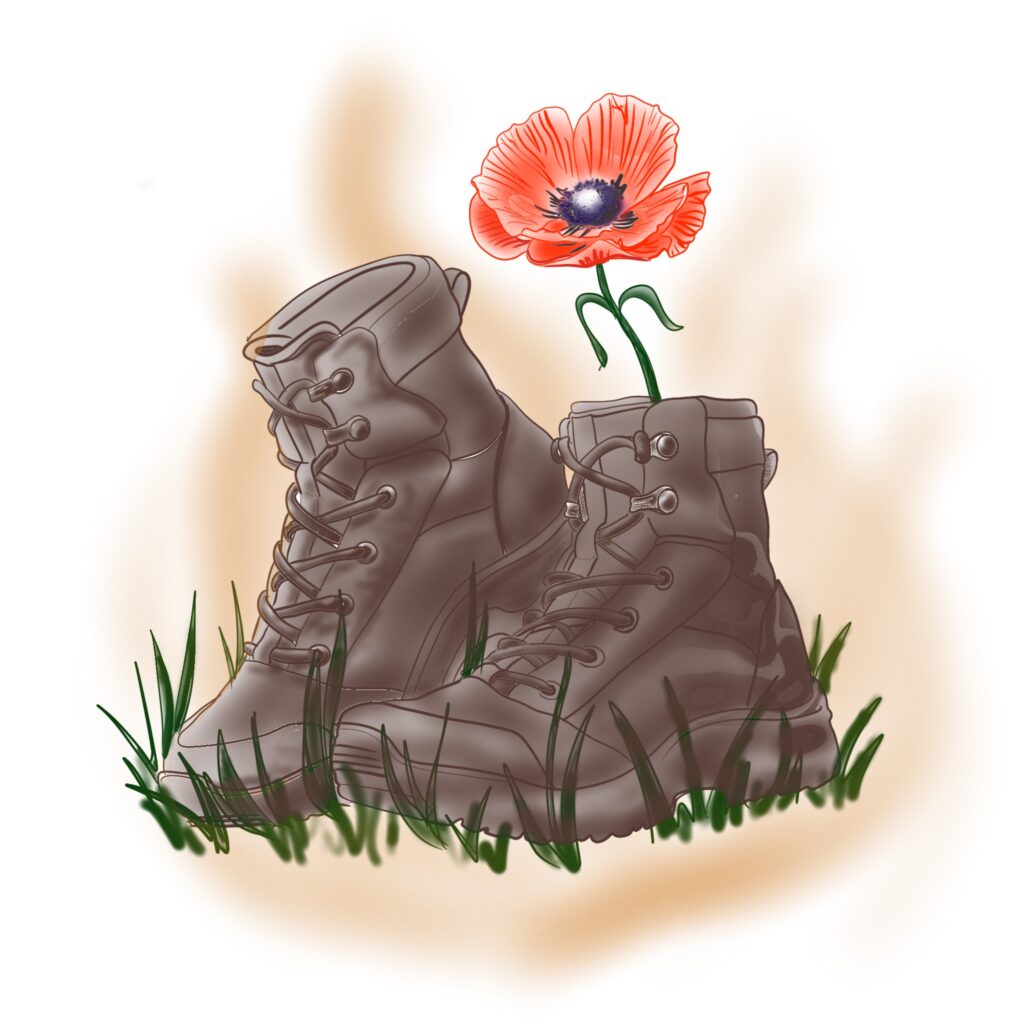
Some weight is carried forward—and given life.
Floral elements are often labeled as “feminine,” but that’s surface-level thinking. Flowers aren’t just decoration. They represent growth, resilience, fragility, and endurance—all things that exist in combat experiences whether people acknowledge them or not.
The point isn’t to make something look softer. The point is to make it more complete.
Balancing Duality Without Diluting Truth
The goal isn’t to strip away the warrior. It’s to show that the warrior is not the only thing there. A well-designed feminine combat tattoo doesn’t hide strength—it reframes it.
It allows multiple truths to exist at once:
- Strength and grief
- Pride and loss
- Violence and beauty
- Memory and growth
That balance is where the real power is. Because it reflects reality—not stereotype.
Designing With Intention
Before putting anything on paper, the most important step isn’t style—it’s understanding.
Questions matter more than references:
- What was her role?
- What did she carry—physically and emotionally?
- What moments stayed with her?
- What does she want to feel when she looks at this years from now?
Because this isn’t about making something that looks feminine. It’s about making something that feels honest to her.
The Bigger Picture
This isn’t just about one tattoo. It’s about expanding the way stories get told.
For a long time, the visual language of military tattoos has been narrow. Not wrong—but incomplete. When you start designing outside of that expectation, you don’t lose meaning. You gain depth.
And more importantly—you give people permission to see themselves in their own story, instead of trying to fit into someone else’s version of it.
Final Thought
A combat tattoo doesn’t have to look a certain way to carry weight. And femininity doesn’t make something less powerful—it just changes how that power is expressed. If anything, it demands more thought, more intention, and more honesty.
And that’s where the best work always comes from.
Leave a Reply