A great tattoo doesn’t just sit on the skin — it moves with it.
The best designs feel like they were always meant to be there, wrapping naturally with the body’s lines, posture, and motion. That’s the difference between a design that looks placed on you and one that feels like it was born for you.
1. The Body Is the Canvas — Not the Page
Tattooing isn’t like painting or drawing on a flat surface. The human body curves, bends, and changes shape every time we move.
A design that looks perfect on paper can lose its power if it doesn’t follow the muscle structure or flow of the body, or is out of proportion.
- The shoulder rolls and flexes — perfect for bold circular or radiating designs like mandalas, eagles, or tribal forms.
- The forearm and bicep are natural “flow zones” — they draw the eye along the arm’s length, ideal for snakes, dragons, or script.
- The ribcage and hip move with every breath — delicate linework or organic shapes that adapt to movement work best here.
This is where technical experience meets intuition. Every tattoo is a conversation between design and anatomy.
2. Understanding Flow — How the Eye Travels
“Flow” is what makes a tattoo feel alive. It’s the invisible rhythm that guides the viewer’s eye across the design in harmony with the body’s motion.
Good flow can make even a simple design dynamic; poor flow can make a masterpiece feel static.
Flow is created by:
- Directional movement: Lines or patterns that follow muscle contours (for example, the forearm’s taper or the spine’s curve).
- Weight and contrast: Heavier shading in certain areas can ground the piece and balance out visual movement.
- Complementary shapes: Soft against sharp, bold against delicate — just like muscle and bone.
When flow is right, a tattoo looks balanced from every angle.
3. Placement Zones — Framing the Art
Each body part has a natural “frame” that enhances different types of artwork.
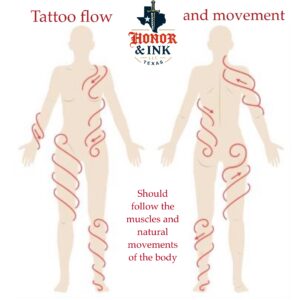
| Zone | Best Suited For | Flow Direction |
| Shoulder / Upper Arm | Circular or symmetrical motifs | Radial / Wrap-around |
| Forearm / Calf | Elongated designs, creatures, script | Linear, down the limb |
| Chest / Back | Large symmetrical or narrative pieces | Center-outward or diagonal |
| Ribs / Side | Organic, flowing designs | Vertical or wavelike |
| Thigh / Hip | Bold shapes, realism, illustrative | Diagonal or curved |
| Hands / Feet / Neck | Simple, bold elements | Straightforward flow |
This chart is intended to give clients a visual sense of how a design should live on their body — not just where to “put it.”
4. Collaboration — The Dialogue of Design
The best tattoos happen when the client and artist communicate clearly about:
- What the tattoo means,
- Where it will go,
- How it should move with their lifestyle and physique.
That’s why I have learned to always design for the body, not against it.
A sleeve flows better when every piece connects, a chest piece feels powerful when it follows the pectoral lines, and a back piece breathes when it mirrors the spine.
5. The Result — Harmony Between Art and Anatomy
When placement and flow are done right, the design doesn’t just look good — it belongs.
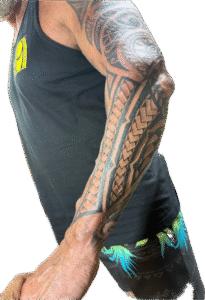
It complements posture, highlights natural movement, and tells a story that evolves with time.
Tattooing isn’t just about marking the skin — it’s about respecting the form beneath it. Every line, curve, and shadow should serve that living canvas.
Thinking about a new piece? Bring your idea — even a rough sketch — and let’s design it to flow with you.
Every tattoo at Honor and Ink™ involves a conversation about placement, movement, and purpose.
Leave a Reply